

REVIEW · WALKING TOURS
Hipstoric Grünerløkka Private Walking Tour
Oslo gets more interesting away from the postcard center. This private three-hour walk leads you from political Youngstorget through Torggata, along the Akerselva River, and into Grünerløkka’s mix of street art, wooden homes, old churches, and food halls. I like the local focus and the chance to see places many first-time visitors skip. I also like that a private guide can shape the conversation around your interests.
The main tradeoff is simple: you pay $237.12 per person for a walk with no food, attraction admissions, or return transport included. That can be good value for a couple or small group that wants a personal introduction to Oslo, but less appealing if you are happy exploring with a map. You will also need moderate fitness and suitable clothing in all weather.
In This Review
- Key points to know before you book
- Starting at Youngstorget, where Oslo speaks loudly
- Torggata and Kulturkirken Jakob, from shopping street to culture church
- Following the Akerselva into Grünerløkka
- Olaf Ryes plass and the Munch connection
- Blå and Brenneriveien, where Oslo’s street art takes over
- Damstredet and Telthusbakken, Oslo’s wooden hillside streets
- Our Saviour’s Memorial Cemetery and Old Aker Church
- Ending at Mathallen Oslo in Vulkan
- What the private format adds
- Is $237.12 per person a fair price?
- Who should book this Oslo walk?
- Should you book the Hipstoric Grünerløkka tour?
- FAQ
- How long is the Hipstoric Grünerløkka tour?
- Where does the tour begin?
- Where does the tour end?
- Is the tour private?
- What language is the tour offered in?
- Is food included in the price?
- Is public transport included after the tour?
- Is Mathallen Oslo open every day?
- Can I cancel for a full refund?
Key points to know before you book
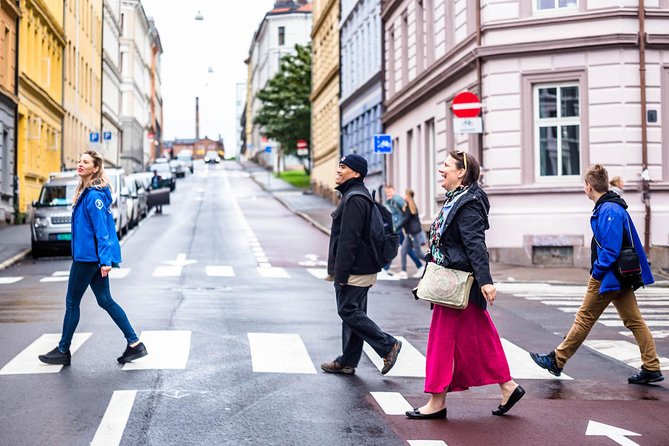
- Youngstorget sets the political tone: Oslo’s rally square introduces the city’s modern public life before the tour turns toward art and neighborhoods.
- The Akerselva crossing marks the change: After the Fairytale Bridge, you enter Grünerløkka, a former working-class district reshaped by gentrification.
- Street art is a major part of the walk: Blå and Brenneriveien offer some of the city’s strongest outdoor art scenes.
- Munch appears in several places: Edvard Munch lived near Olaf Ryes plass and painted Telthusbakken, while his grave is visited later.
- The churches add real depth: Kulturkirken Jakob, Old Aker Church, and Our Saviour’s Memorial Cemetery show very different sides of Oslo’s cultural life.
- The finish is practical: The tour ends at Mathallen Oslo in Vulkan, where you can eat, continue exploring, or walk back toward the starting point.
Starting at Youngstorget, where Oslo speaks loudly
The tour begins at Youngstorget, a useful meeting point near the center of Oslo. This square is closely tied to Norwegian political life. Political speeches and rallies take place here, including events connected with women’s rights and gay pride. Its location near the Government quarter also explains why political organizations have offices nearby.
I appreciate this opening because it gives you a quick lesson in how public space works in Norway. Youngstorget is not just a place to pass through on the way to somewhere else. It is a square where national issues become visible in city life.
Your guide can help connect the buildings and organizations around the square with Norway’s political culture. The tour then moves into Torggata, whose name means Square Street. The street is also represented in the Norwegian edition of Monopoly, a small detail that gives the route an easy, local point of reference.
The first two stops are listed at about ten minutes each. Do not expect a long formal lecture at every location. The value is in the connections between them, with your guide explaining what you are seeing as you walk.
More Walking Tours in Oslo
- Oslo: Best of Oslo Walking Tour
★ 4.5 · 458 reviews - Oslo: Guided Walking Tour of Central Oslo
★ 4.7 · 438 reviews - Oslo: Historic Myths & Legends Evening Walking Tour
★ 4.8 · 408 reviews
Torggata and Kulturkirken Jakob, from shopping street to culture church
Torggata helps shift the mood from formal politics to everyday city life. Its Monopoly connection may sound minor, but it shows how familiar the street is within Oslo. A private guide can give you more context than a standard sightseeing route, especially if you ask about how the street has changed.
Kulturkirken Jakob, also called the Culture Church, offers a sharper change of pace. The building is rented long-term by Kirkelig Kulturverksted and functions as a setting for theatre, concerts, dance, and other forms of cultural expression.
This is one of the tour’s more unusual stops. You are not simply looking at an old church and hearing a date. You are seeing a religious building used as a cultural venue. That contrast helps explain Oslo’s arts scene, which is not confined to museums and concert halls.
The stop is scheduled for about ten minutes. Depending on the day, you may mainly see the exterior and hear about the church’s role. The supplied information does not promise entry or a live event, so do not book this walk expecting a performance.
Following the Akerselva into Grünerløkka
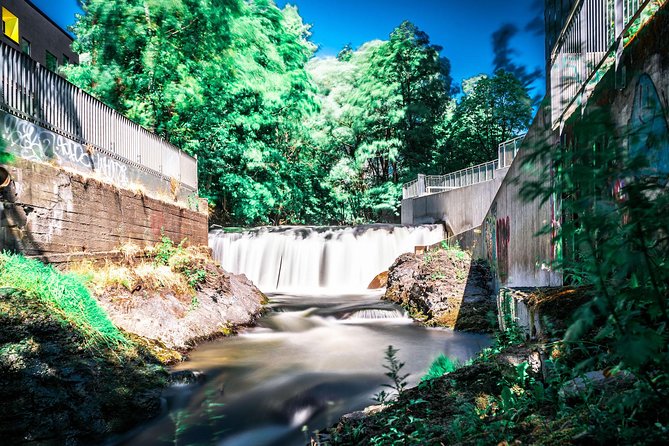
The Akerselva River is one of the most important parts of the route. It runs through Oslo and is known as the city’s green lung because of the parks and nature trails along its banks.
This section should appeal to you if you like seeing how a capital city makes room for paths, trees, and water. It also gives the walk a welcome break from streets and buildings. The route is not a museum-to-museum march. You are moving through a part of Oslo that links urban neighborhoods with outdoor space.
After crossing the river and the Fairytale Bridge, you officially enter Grünerløkka. The district began as a working-class area, then went through a gentrification process late in the 20th century. That change is central to understanding the neighborhood today.
Your guide can point out the tension between old working-class roots and newer creative businesses. The appeal of the district is not that it has one fixed identity. It is the mix of past and present, with old buildings, cultural venues, public art, and new development sharing a small area.
Olaf Ryes plass and the Munch connection
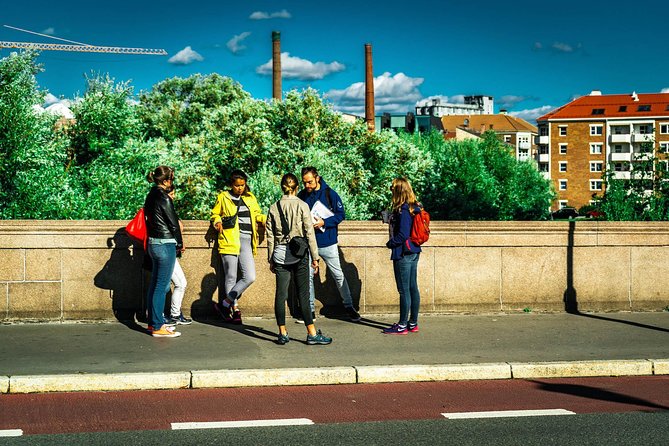
Olaf Ryes plass is surrounded by three- and four-story buildings, most built in the late 1800s. The park gives you a good sense of Grünerløkka’s older residential character without requiring a long detour.
Edvard Munch lived in one of the nearby buildings when he was young. That detail adds a personal link to the area. You are not only looking at a pretty park. You are standing near one of the places connected with a major Norwegian artist before he became internationally famous.
The park also sits beside Parkteatret, now one of Oslo’s well-known concert venues. This pairing captures the district nicely: older apartment buildings, public green space, and a current arts venue all close together.
You will spend about ten minutes here. If you want a deeper look at Munch’s work, this tour will not replace a visit to an art museum. Its strength is showing you the city setting around the artist’s life.
A completely different kind of day:
- Oslo: Scenic Fjord Cruise with Audio Guide Commentary
★ 4.5 · 5,375 reviews - Oslo Nature Walks: Island Hopping Tour
★ 4.8 · 2,713 reviews - Oslo: 100% Electric Oslofjord Sightseeing Cruise
★ 4.4 · 2,041 reviews - Oslo: Fjord Evening Cruise with Shrimp Buffet
★ 4.5 · 1,956 reviews
Blå and Brenneriveien, where Oslo’s street art takes over
The area around Blå is one of the highlights for street art in Oslo. Blå is an alternative music venue, and the surrounding walls and spaces form an important outdoor art stop. Bring your camera, but remember that street art can change. Murals may be painted over, altered, or replaced.
Brenneriveien continues the same theme. Old, unused industrial buildings have been turned into a street art setting by local art students. This is a strong example of how disused urban spaces can become part of a city’s cultural life.
I like this part of the walk because it gives you something you cannot experience in quite the same way inside a gallery. The art is tied to walls, alleys, industrial buildings, and the neighborhood around it. Your guide’s explanation can help you see the area as more than a collection of colorful photographs.
There is also a practical limit. Street art is weathered and temporary, and the experience depends on what is currently visible. The tour promises the area, not a guaranteed list of particular works.
Damstredet and Telthusbakken, Oslo’s wooden hillside streets
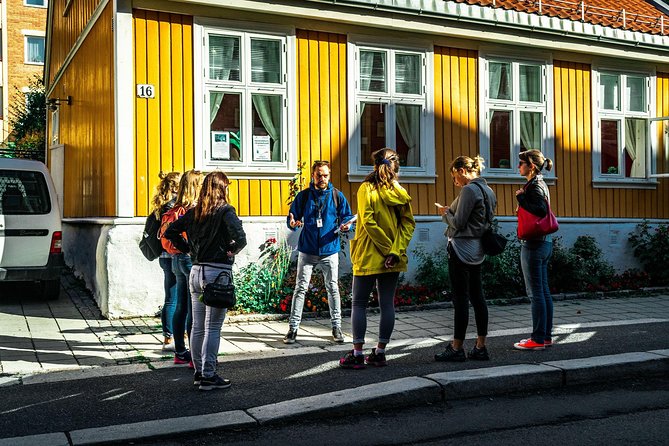
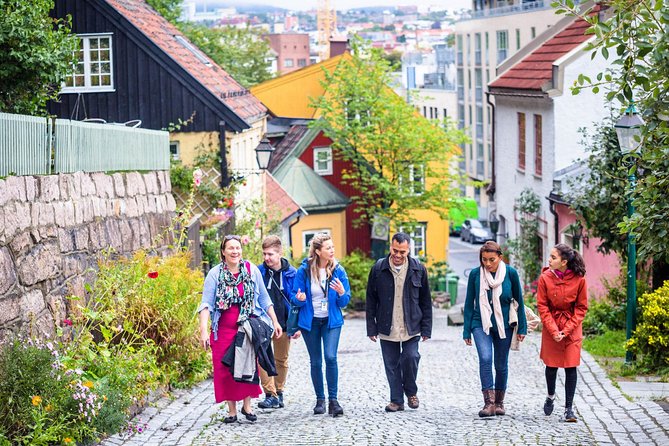
Damstredet brings the route into a quieter, more traditional setting. Its wooden houses are well preserved and still inhabited. The hillside homes make a natural photo stop, but you should remember that this is a residential street, not an open-air museum.
That distinction matters. You are seeing real homes where people live. Keep voices low, avoid blocking paths, and take photographs with care. The charm comes partly from the fact that the street remains part of daily life.
Telthusbakken offers another group of colorful wooden houses. One side of the street is home to about 50 people, while allotment gardens sit on the other side. The street was also a subject in one of Edvard Munch’s paintings.
These two stops offer a useful contrast with Grünerløkka’s street art. Instead of industrial walls and large murals, you get small houses, gardens, slopes, and a strong sense of scale. If you want to understand how varied Oslo can look within a short walk, this section delivers.
Our Saviour’s Memorial Cemetery and Old Aker Church
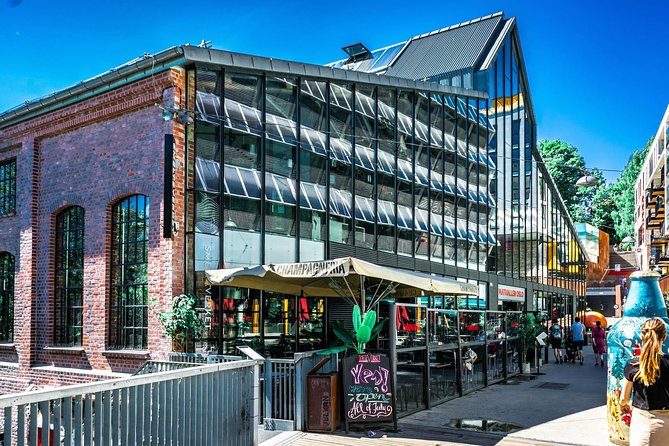
Our Saviour’s Memorial Cemetery is a meaningful stop for anyone interested in Norwegian culture. Edvard Munch and playwright Henrik Ibsen are among the famous Norwegians buried here.
The cemetery is not simply a list of notable names. It places two major figures in a real Oslo setting, close to the neighborhoods and streets connected with the city’s artistic life. Your guide’s commentary is especially useful here because the significance may not be obvious from the paths alone.
The stop lasts about fifteen minutes, making it one of the longer visits on the route. That gives you a little more time to pause and take in the surroundings.
Old Aker Church follows with a different kind of history. Gamle Aker Kirke is Oslo’s oldest remaining building and the city’s only remaining medieval church. Even if you have already seen newer churches elsewhere in Oslo, this stop adds a much older layer to the walk.
The supplied details do not promise interior access, so plan to learn about the church rather than assume you will tour inside. Still, its age gives the route useful balance. You move from modern political life and current street art to medieval Oslo in the space of one afternoon.
Ending at Mathallen Oslo in Vulkan
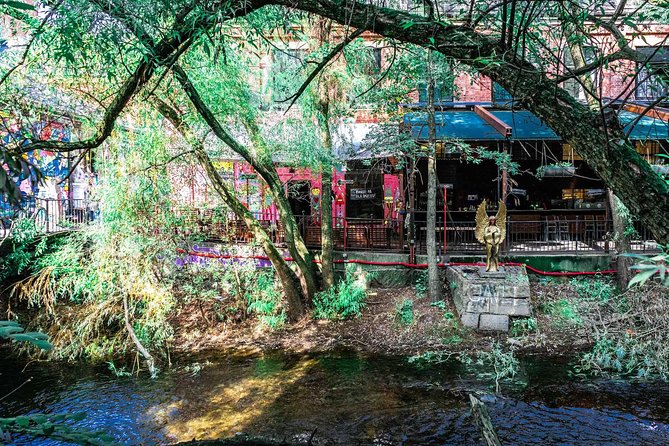
The final stop is Mathallen Oslo, located in the Vulkan district beside the Akerselva. This area was once heavily industrial. It has since become a major city development project, with the food hall as one of its main attractions.
Ending here is smart. You finish with a choice instead of being dropped at an isolated point. You can continue exploring Grünerløkka, stop for food at Mathallen, or make your way back toward the center.
Mathallen offers options for many tastes, but food is not included in the tour price. You should also note that Mathallen is closed on Mondays. If you are taking the tour on a Monday, the walk still ends in Vulkan, but the food hall will not be available as your post-tour stop.
The return journey is your responsibility. It is about a 15-minute walk, roughly 1 kilometer, back to Youngstorget, or you can use public transport. Your transport ticket is not included.
What the private format adds
A private tour means only your group takes part. This is the biggest reason to consider the price. You can ask questions about Oslo’s politics, Munch, street art, architecture, or present-day neighborhood life without trying to get the guide’s attention in a large group.
The tour is offered in English and includes a professional guide. Two guides named in the feedback are Inger and Björn. Inger received especially warm praise for her passion and ability to answer questions about Oslo’s culture and history. Björn was also praised for clear, informative commentary.
The strongest recurring point is the guide’s depth of explanation. The tour is not only about checking off places. It is designed to help you understand how locals live, how districts change, and why art appears in unexpected corners.
The schedule lists thirteen stops, most at about ten minutes, with fifteen minutes at the cemetery. Since the full experience lasts about three hours, the remaining time is spent walking between them. Wear comfortable shoes. The route includes urban streets, a river crossing, parks, hills, and older residential lanes.
Is $237.12 per person a fair price?
At $237.12 per person, this is not a budget walk. Its value depends heavily on the size of your group and how much you want personal attention.
For two people, the cost is a serious splurge. For a larger private group, especially with a group discount, the price may feel more reasonable when divided among everyone. You are paying for a guide, a private format, and a route that combines politics, art, architecture, cemeteries, churches, and food culture in one outing.
You are not paying for meals, museum tickets, or transport. Every listed stop is free, which keeps extra costs low apart from what you choose to eat or drink afterward.
I would compare this with the cost of arranging your own route and researching each neighborhood. If you enjoy planning, you can walk many of these streets independently. If you want context, local insight, and an easy route through less familiar parts of Oslo, the private format gives the price a clearer purpose.
Who should book this Oslo walk?
I would recommend it most to:
- First-time Oslo visitors who have already seen the main central sights
- Couples and small groups that value a private guide
- People interested in street art, local neighborhoods, and urban change
- Art lovers who want Munch connections outside a museum
- Visitors who enjoy walking and can manage moderate physical activity
- Anyone looking for a flexible conversation rather than a scripted bus tour
You may want to skip it if your time in Oslo is very short and you need major sights such as the city’s best-known museums or landmarks. It may also be a poor fit if you dislike hills, walking in wet weather, or paying a premium for a private experience.
The tour operates in all weather. Dress for Oslo’s conditions, and wear shoes that can handle three hours on foot.
Should you book the Hipstoric Grünerløkka tour?
Book it if you want to see Oslo as a living city rather than a checklist of famous sights. The best parts are the transition along the Akerselva, the street art around Blå and Brenneriveien, the wooden homes at Damstredet and Telthusbakken, and the thoughtful connections to Munch, Ibsen, politics, and local culture.
The price is the main question. I would choose it for a small group that wants a personal guide and a well-shaped route through Grünerløkka. I would skip it for a solo budget visit or if you prefer exploring independently.
For the right group, this is a smart way to spend three hours in Oslo. You finish at Mathallen, with time to eat, keep walking, or return to the center on your own.
FAQ
How long is the Hipstoric Grünerløkka tour?
The tour lasts approximately three hours.
Where does the tour begin?
It begins at Youngstorget in Oslo, Norway.
Where does the tour end?
It ends at Mathallen Oslo in the Vulkan area of Grünerløkka.
Is the tour private?
Yes. Only your group participates in the activity.
What language is the tour offered in?
The tour is offered in English.
Is food included in the price?
No. Food at Mathallen Oslo or elsewhere is not included.
Is public transport included after the tour?
No. You make your own way back. The walk to Youngstorget is about 15 minutes, or roughly 1 kilometer, and public transport is also available with a separate ticket.
Is Mathallen Oslo open every day?
Mathallen Oslo is closed on Mondays.
Can I cancel for a full refund?
Yes, if you cancel at least 24 hours before the experience start time. Cancellations made less than 24 hours in advance are not refunded, and changes within that period are not accepted.
Just added in Oslo
- Oslo Winter Highlights Bike Tour★ 5.0 · 36 reviews
- 4 hours Best View of the Oslofjord Winter Edition★ 4.0 · 15 reviews
- Unknown war. Oslo and Norway during 1940-45★ 5.0 · 74 reviews
- The Ultimate Study of the Human Form at Vigeland’s Sculpture Park with a Local★ 4.0 · 14 reviews
- Top of Oslo Snowshoe Tour★ 5.0 · 2 reviews
- The Scenic Roadtrip, Oslo to Bergen via Flam & the Fjords★ 5.0 · 25 reviews
- The Viking Planet Museum – Mini Group (4 adults)★ 4.0 · 16 reviews
- The Oslo Beer Adventure★ 4.5 · 11 reviews
Walking Tours, compared.
Past & Present Small Group Guided Walking Tour
Read our review →
Walking Tour in Bergen of the Past and Present
Read our review →

Browse the lists this tour appears in