

REVIEW · WALKING TOURS
Central Oslo Guided Walking Tour with Local Guide
Oslo opens up on foot. This two-hour walk links the city’s best-known sights, from the Tiger sculpture at the railway station to the Royal Palace, while a local guide adds history, humor, and useful bearings. I especially like the low price of $16.94 and the way the route connects old streets, waterfront districts, royal landmarks, and political buildings in one morning.
I also like the range of guides who lead this experience. Suzanne, Alexia, Marta, Kamil, Daniel, and others have been praised for clear explanations, friendly conversation, and good local tips. The main consideration is that this is a walking overview, not a building tour. You will see many landmarks, but visits inside buildings are not included, and the route covers several city blocks.
In This Review
- Key points to know before you book
- Starting with Oslo’s Tiger at Jernbanetorget
- Oslo Opera House and the waterfront view
- Rådhusgata and the older city center
- Akershus Fortress, Oslo’s medieval defense
- Oslo City Hall and Nobel Peace Prize connections
- Oslo Cathedral and the main street
- Aker Brygge and Oslo’s harbor-side face
- Norway’s Parliament and the Royal Palace finish
- How the guiding affects the experience
- Price, pace, weather, and practical value
- Who should book this Oslo walk?
- Should you book it?
- FAQ
- How long does the Central Oslo Guided Walking Tour last?
- Where does the tour begin?
- Where does the tour finish?
- What language is the tour offered in?
- Is admission to Oslo’s buildings included?
- Can I enter Akershus Castle during the tour?
- How large can the group be?
- Is the tour suitable for people who use service animals?
- Can I cancel for a full refund?
Key points to know before you book
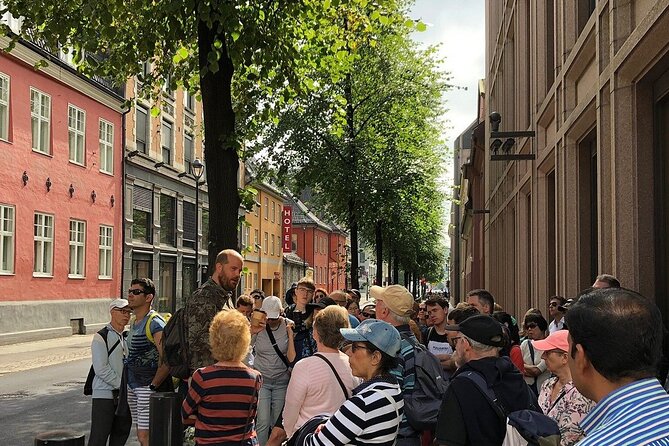
- The route begins beside Oslo Central Station: Meeting at the Tiger sculpture makes the starting point easy to find and convenient for public transportation.
- You cover Oslo’s major central sights in about two hours: The walk includes the Opera House, Akershus Fortress, City Hall, Oslo Cathedral, Karl Johans gate, Aker Brygge, Parliament, and the Royal Palace.
- The guide is the main attraction: The best guides add Scandinavian history, Norwegian culture, local facts, and humor rather than simply pointing at buildings.
- Akershus Fortress is viewed without indoor admission: The tour includes the fortress area, but the price does not cover entry inside any buildings.
- The group can reach 27 people: That is manageable when the guide uses a microphone, though a larger group can make questions and hearing more difficult.
- It works best early in your Oslo stay: The route gives you a practical map of central Oslo and helps you decide where to spend more time afterward.
Starting with Oslo’s Tiger at Jernbanetorget
The meeting point is the Tiger sculpture at Jernbanetorget, the square outside Oslo Central Station. The location is practical rather than romantic, but that is part of its value. You can reach it easily by public transportation, and the large bronze animal gives you a clear landmark for meeting your guide.
The Tiger was installed in 2000 to mark Oslo’s millennium. It also connects to Oslo’s nickname, Tiger City. The name comes from a poem comparing a city to a tiger and the countryside to a gentle horse, a memorable image for a capital that has long balanced urban life with access to nature.
This first stop takes about 10 minutes and admission is free. Do not expect a long lecture here. The guide uses the sculpture as a quick opening lesson about Oslo’s identity, then gets you moving through the center.
I like this start because it avoids wasting time on a complicated meeting point. If you are arriving by train, you can step off the platform, find the Tiger, and begin. Arrive with a few minutes to spare, since a city-center square can be busy and the group may move on promptly.
More Walking Tours in Oslo
- Oslo: Best of Oslo Walking Tour
★ 4.5 · 458 reviews - Oslo: Guided Walking Tour of Central Oslo
★ 4.7 · 438 reviews - Oslo: Historic Myths & Legends Evening Walking Tour
★ 4.8 · 408 reviews
Oslo Opera House and the waterfront view
The Opera House is one of the most modern-looking stops on the route. Completed in 2008, it is home to the Norwegian National Opera and Ballet and is known for its white, angular design beside the water.
The building is meant to be seen as part of the public space around it. Its sloping exterior makes the architecture feel less like a sealed cultural institution and more like a place connected to the harbor. On a walking tour, you get the important visual impression and the guide’s explanation without spending time inside for a performance or building visit.
This is a good early reminder that Oslo is not only a medieval or royal city. The route shifts between old streets and newer architecture, showing how the capital has changed. I find that contrast more useful than seeing a string of similar monuments.
The tour does not specify indoor entry at the Opera House, so plan on an exterior visit. If the weather is wet, the smooth open spaces around the building may feel less inviting, though the stop is still worthwhile for photographs and orientation.
Rådhusgata and the older city center
From the newer waterfront architecture, the walk turns toward Rådhusgata. This street dates from the 1620s and leads toward Oslo City Hall. It gives the guide a chance to explain how the central city developed after earlier periods of change and rebuilding.
Rådhusgata is not the sort of place you visit for one dramatic photo. Its value is in the sequence. You begin to see how Oslo’s streets connect the harbor, government buildings, religious sites, and commercial center.
This is also where a strong guide can make the difference between a pleasant walk and a forgettable one. The best guiding reported from this tour has included the changing relationship between Norway, Denmark, and Sweden, along with stories about national rivalries and Norwegian culture. Those details give the buildings a setting instead of leaving you with a list of dates.
Akershus Fortress, Oslo’s medieval defense
Akershus Fortress is the route’s main medieval stop. It was built in the late 13th century, around 1299, to protect Oslo from invasion. Over time, it served as a military base and prison, and it is now a historic site and museum.
The fortress is especially useful for understanding Oslo’s position beside the water. Its defensive purpose makes sense once you see its relationship to the harbor. A guide can help you connect the stone walls and military setting to the city’s earlier political and strategic importance.
One detail deserves careful attention: the tour information describes Akershus as a museum and historic site, but the included services clearly say that no visits inside buildings are included. You should therefore expect to see the fortress and hear its story, not receive museum admission or an interior castle visit as part of the $16.94 fee.
That distinction matters if entering medieval rooms is a priority. You could use the walking tour to learn where Akershus is, then return later if you want to explore more on your own, subject to the site’s opening arrangements. The tour itself keeps moving, so this is an introduction rather than a full fortress visit.
A completely different kind of day:
- Oslo: Scenic Fjord Cruise with Audio Guide Commentary
★ 4.5 · 5,375 reviews - Oslo Nature Walks: Island Hopping Tour
★ 4.8 · 2,713 reviews - Oslo: 100% Electric Oslofjord Sightseeing Cruise
★ 4.4 · 2,041 reviews - Oslo: Fjord Evening Cruise with Shrimp Buffet
★ 4.5 · 1,956 reviews
Oslo City Hall and Nobel Peace Prize connections
Oslo City Hall is another major stop, with about 15 minutes set aside for the area. The building was constructed between 1931 and 1950 and is closely tied to Norway’s civic and cultural life.
The City Hall is also associated with the annual Nobel Peace Prize ceremony. That gives the stop wider importance than its municipal function. Your guide can connect the building to Norway’s public institutions and the country’s role in international affairs.
The timing here is long enough for a proper explanation and a few questions. That is helpful because City Hall can look imposing but not immediately self-explanatory. You get a clearer sense of why it matters before moving on.
Again, no interior building visits are included. You should not book this tour expecting a guided look inside City Hall. The benefit is the location, exterior view, and context supplied by the guide.
Oslo Cathedral and the main street
The Oslo Cathedral dates to 1697 and is known for Baroque architecture. It has been renovated several times, including major work in the 20th century, and remains an important religious and cultural site.
The cathedral adds another layer to the walk. Akershus speaks to defense, City Hall to civic life, and the cathedral to religious history. The tour does not linger at each subject for a long time, but the combination gives you a useful first picture of the city.
From there, the route reaches Karl Johans gate, Oslo’s main street. It stretches from Oslo Central Station to the Royal Palace and brings together shops, restaurants, historic buildings, and cultural sights.
Karl Johans gate is the most practical part of the tour for getting your bearings. After walking it with a guide, you will know how the station, cathedral, Parliament, palace, and central shopping area relate to one another. I would pay close attention here if you are staying in central Oslo, since this street becomes a useful reference point for the rest of your visit.
A stop here lasts about 10 minutes. The pace is generally described as easy or leisurely, but the route still covers many blocks. You will not be standing in one square for two hours.
Aker Brygge and Oslo’s harbor-side face
Aker Brygge shows a different side of Oslo. The district began as a shipyard in 1854 and was transformed into its present shopping, dining, and entertainment role in the 1980s.
This conversion from industrial waterfront to public district is a useful piece of modern Oslo. You can see how the harbor has been brought into everyday city life, with places to eat, shop, and spend time near the water.
The route does not promise time for a meal or shopping, so think of Aker Brygge as a guided orientation stop rather than a free afternoon. If you like the area, mark it for a return visit after the tour. The guide can also help you understand where this district sits in relation to City Hall and the rest of the center.
Aker Brygge is one reason the tour feels broader than a standard old-town walk. You get medieval defenses, 17th-century streets, 19th-century institutions, modern architecture, and a redeveloped harbor in one compact route.
Norway’s Parliament and the Royal Palace finish
The Storting building is home to the Norwegian Parliament. Constructed between 1861 and 1866, it represents the country’s legislative life and adds a political stop to the route.
You will see how close the major civic buildings are to one another. Parliament, the cathedral, Karl Johans gate, and the palace all sit within the central walking area, which makes this tour especially useful for first-time visitors who want a mental map rather than isolated sightseeing stops.
The tour finishes at Slottsplassen, the square in front of the Royal Palace, also called Det Kongelige Slott. You get a view of this important landmark, but the experience does not include a palace interior visit.
Ending here is practical. From the palace, you can continue exploring the central streets, return toward Karl Johans gate, or follow your own plans. The finish also gives the tour a clear sense of direction, moving from the railway station through the historic and civic center to the royal end of the city.
How the guiding affects the experience
The strongest part of this tour is the guide. The most praised guides have included Suzanne, Alexia, Marta, Kamil, and Daniel. Their best qualities are repeated often: friendly delivery, humor, clear historical explanations, and a willingness to answer questions.
Daniel has been particularly effective with a large group, keeping people together while mixing facts with jokes. Alexia has been praised for explaining Norwegian culture as well as history. Marta has been described as personable and good at offering suggestions for other places to visit.
The experience can vary by guide. One poor account described the information as sparse and surface-level, while another noted that a guide spoke quickly even though she used a microphone. That is a fair warning. This is a short public walking tour, so the depth of information may depend on the individual guide and the size of the group.
The operator may use a portable speaker system, which helps in city noise. Still, stay near the guide if you want to catch every detail. With up to 27 people, the group is not tiny, and a large crowd can make spontaneous conversation less personal.
Price, pace, weather, and practical value
At $16.94 per person, this is a strong-value introduction to central Oslo. You are paying mainly for the guide’s route, commentary, and local perspective. Since admission to buildings is not included, the price works best if you want orientation and context rather than a series of paid indoor attractions.
Two hours is enough to cover the main center without turning the morning into an endurance test. The walking pace has been described as gentle and manageable, but you should still expect several blocks between stops. Anyone with walking difficulties should consider the distance, stairs, and weather before booking.
The tour is offered in English and uses a mobile ticket. Confirmation arrives at booking, and service animals are allowed. It operates near public transportation, which makes both the meeting point and the rest of your day simple to organize.
Dress for the forecast. The experience requires good weather and may be canceled if conditions are poor. You can receive another date or a full refund in that case. You can also cancel for a full refund up to 24 hours before the start time, while later cancellations and changes are not accepted.
Who should book this Oslo walk?
I would choose this tour for a first day in Oslo, especially if you want to understand the layout before visiting museums or returning to favorite districts. It suits solo visitors, couples, families, and anyone who prefers a short introduction with a human voice rather than a self-guided route.
It is also a good fit if you enjoy history but do not want a lecture. The best guides add humor and practical explanations, and the route includes enough variety to keep the two hours moving.
I would hesitate if your main goal is entering Akershus Fortress, Oslo City Hall, the Opera House, the cathedral, Parliament, or the Royal Palace. You will see the major landmarks from the route, but indoor admission is not included. I would also choose another format if you want a very small private group or highly detailed architectural study.
Should you book it?
Book this walk if you want an inexpensive, well-paced introduction to central Oslo with history, local context, and a clear route from the station to the Royal Palace. The 4.7 rating from 278 reviews and 94 percent recommendation rate fit the overall picture: most people get a useful and enjoyable city overview.
For the best experience, schedule it near the start of your stay, keep close enough to hear the guide, and treat each landmark as an introduction rather than a full visit. The value is not in checking off buildings. It is in learning how Oslo’s medieval fortress, harbor, cathedral, Parliament, shopping street, and palace fit together.
FAQ
How long does the Central Oslo Guided Walking Tour last?
The tour lasts approximately two hours.
Where does the tour begin?
It begins at the Tiger sculpture at Jernbanetorget, 0154 Oslo, Norway.
Where does the tour finish?
It finishes at Slottsplassen in front of the Royal Palace, Det Kongelige Slott, at Slottsplassen 1, 0010 Oslo.
What language is the tour offered in?
The tour is offered in English.
Is admission to Oslo’s buildings included?
No. Visits inside buildings are not included in the tour.
Can I enter Akershus Castle during the tour?
The route includes Akershus Fortress, but indoor admission is not included. Expect an introduction to the fortress area rather than entry into its buildings.
How large can the group be?
The tour can have a maximum of 27 travelers.
Is the tour suitable for people who use service animals?
Yes. Service animals are allowed.
Can I cancel for a full refund?
Yes, if you cancel at least 24 hours before the experience start time. Cancellations or changes made less than 24 hours beforehand are not accepted for a refund.
Just added in Oslo
- Oslo Winter Highlights Bike Tour★ 5.0 · 36 reviews
- 4 hours Best View of the Oslofjord Winter Edition★ 4.0 · 15 reviews
- The Ultimate Study of the Human Form at Vigeland’s Sculpture Park with a Local★ 4.0 · 14 reviews
- Unknown war. Oslo and Norway during 1940-45★ 5.0 · 74 reviews
- Top of Oslo Snowshoe Tour★ 5.0 · 2 reviews
- The Scenic Roadtrip, Oslo to Bergen via Flam & the Fjords★ 5.0 · 25 reviews
- The Viking Planet Museum – Mini Group (4 adults)★ 4.0 · 16 reviews
- The Oslo Beer Adventure★ 4.5 · 11 reviews
Walking Tours, compared.

Past & Present Small Group Guided Walking Tour
Read our review →
Walking Tour in Bergen of the Past and Present
Read our review →

Browse the lists this tour appears in