
REVIEW · CITY TOURS
Oslo City Walks – The City of Contrasts
Oslo changes before your eyes. This two-hour walk links the city’s bold new waterfront buildings with the older streets of Kvadraturen, giving you a clear picture of how modern Oslo is growing around its past. I like the route’s strong visual variety, especially the Opera House and the changing Bjørvika district. I also like the small group limit of 20 people, which should make it easier to hear the guide. The main drawback is timing: the 5:00 pm start and outdoor route mean you need to dress for Oslo weather, and the Munch Museum admission is not included.
The tour costs $53.31 per person, which is not pocket change for a two-hour walk. Still, the price includes a local guide and a route that ties together several major sights without asking you to plan the connections yourself. If you want a quick introduction to Oslo’s new waterfront and historic center, it offers solid value. If you mainly want museum interiors, this is not the right choice.
In This Review
- Key points to know before you book
- Why this route explains Oslo so well
- Starting at the Opera House roof
- Bjørvika and the new Munch Museum
- Crossing the Akrobaten Pedestrian Bridge
- Kvadraturen and Oslo’s older civic center
- What the $53.31 price really buys you
- Timing, meeting points, and practical comfort
- Who will get the most from this walk
- Cancellation and booking flexibility
- Should you book Oslo City Walks?
- FAQ
- How long is Oslo City Walks, The City of Contrasts?
- What time does the tour begin?
- Where does the tour meet?
- Where does the tour finish?
- Is admission to the Munch Museum included?
- Is the Opera House roof visit guaranteed?
- Is the tour available in English?
- What happens if the weather is bad?
- Can I cancel for a refund?
Key points to know before you book
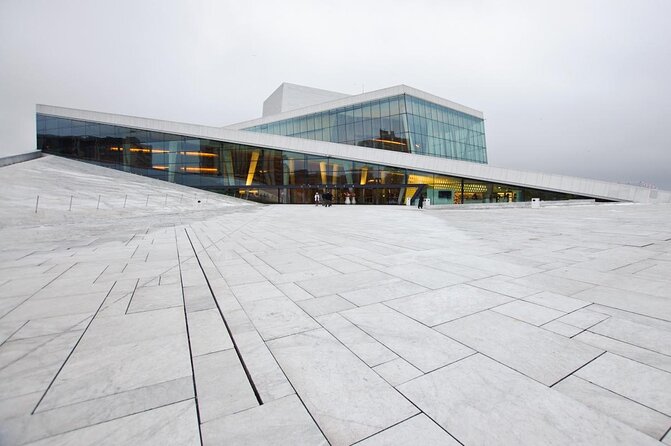
- The Opera House roof is the visual highlight: If time allows, you can walk up onto the building’s sloping roof for free views across Bjørvika.
- Bjørvika tells Oslo’s modern story: The former container port is being reshaped into a cultural district, with the Munch Museum as its newest major attraction.
- The route includes the Akrobaten Bridge: This pedestrian bridge links Grønland and Bjørvika and gives the walk a useful look at how Oslo’s districts connect.
- Kvadraturen adds historical balance: You visit the old town area, including the site of the original town hall and Oslo’s oldest restaurant.
- It is a compact, guided introduction: The tour lasts about two hours, begins at Oslo Visitor Center at 5:00 pm, and ends at Deichman Bjørvika.
- The format is easy to manage: A mobile ticket, English-language guiding, free cancellation up to 24 hours before departure, and a maximum of 20 people keep the practical side simple.
Why this route explains Oslo so well
Oslo can feel like two cities at once. One side is clean-lined, newly built, and focused on art, architecture, and public spaces. The other is older, more compact, and tied to the city’s earlier civic and commercial life.
This walking tour uses that contrast as its organizing idea. Instead of showing you a string of unrelated sights, it moves through areas that reveal how Oslo is changing. You see what a former port is becoming, how new cultural buildings reshape a waterfront, and how older districts remain part of the city’s identity.
I think that approach is more useful than a standard highlight walk. You get a basic sense of Oslo’s past, but you also see the city as a work in progress. The guide’s role matters here. One review praises the guide as terrific, enthusiastic, and well informed, which is exactly the kind of leadership this route needs. The buildings are easy to admire on your own. The value comes from understanding why they are there and how the surrounding neighborhoods fit together.
The group size is capped at 20 people. That is large enough to create a social walking experience but small enough to be more manageable than a big coach-style group. You should still expect to walk at a steady pace and remain outdoors for much of the experience.
A few more options to weigh up in Oslo
- Oslo: Scenic Fjord Cruise with Audio Guide Commentary
★ 4.5 · 5,375 reviews - Oslo Nature Walks: Island Hopping Tour
★ 4.8 · 2,713 reviews - Oslo: 100% Electric Oslofjord Sightseeing Cruise
★ 4.4 · 2,041 reviews
Starting at the Opera House roof
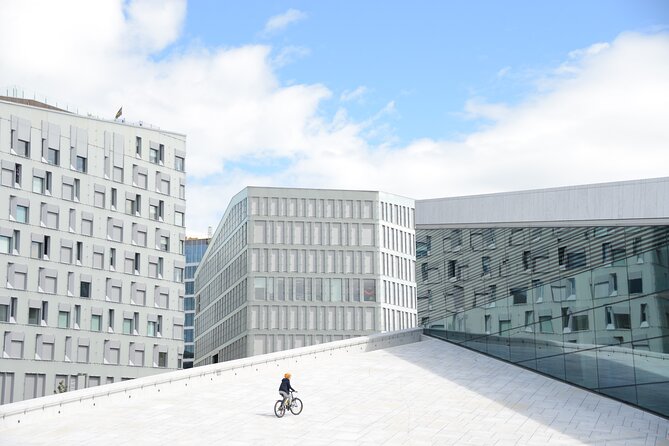
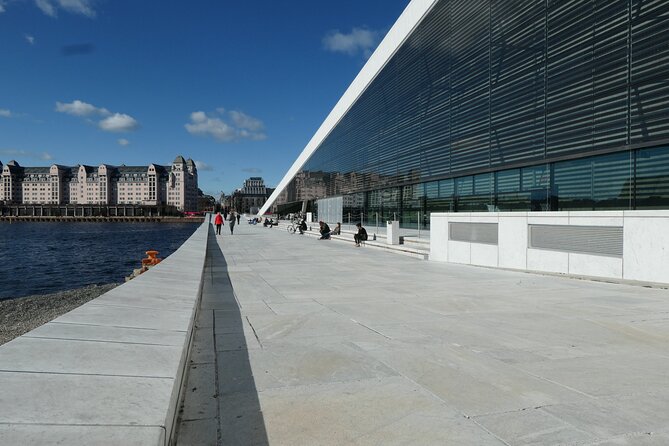
The walk begins at the Norwegian National Opera & Ballet, one of Oslo’s most recognizable modern buildings. Its design encourages people to walk over the structure rather than simply look at it from the street. The broad, sloping roof rises from the waterfront, creating a public route above the building.
If time allows, the guide takes you onto the roof. There is no admission charge for this part, and it is one of the tour’s best inclusions. From the roof, you can look across the Bjørvika area and see the relationship between the harbor, the newer cultural buildings, and the city behind them.
I like this stop because it gives you an immediate sense of Oslo’s public design philosophy. The Opera House is not presented as a sealed monument that you admire from a distance. Its roof is part of the city’s walking space. That makes the building easier to understand and more fun to experience.
The wording if time allows is important. The roof visit is not guaranteed as a long, leisurely stop. The tour lasts about two hours, and the guide has several areas to cover. If reaching the roof matters most to you, arrive ready to start on time and avoid assuming that every minute will be available for photos.
The roof can also be affected by conditions underfoot. The tour operates in all weather, so sensible shoes and weather protection are useful. Oslo’s weather can change quickly, and an exposed roof is not the place to discover that your jacket is decorative rather than waterproof.
Bjørvika and the new Munch Museum
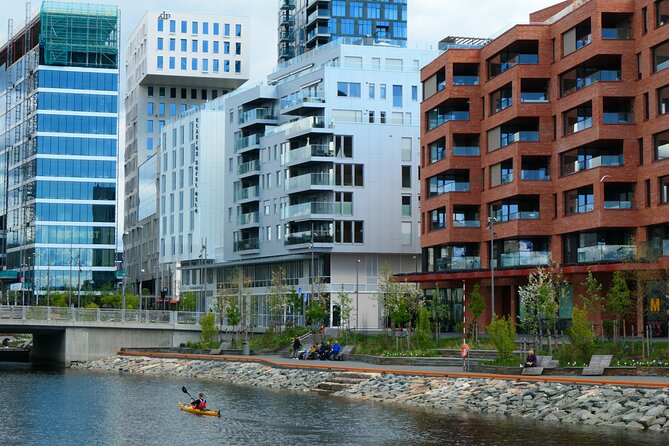
From the Opera House, the route continues through Bjørvika, one of the most rapidly changing parts of Oslo. The area was once associated with container shipping. It is now being transformed into a cultural center, with public buildings and pedestrian routes changing how people use the waterfront.
The Munch Museum is the main stop here. It opened in October 2021 and is described as the newest major attraction in this part of the city. The tour allows about 20 minutes at the museum, but admission is not included in the price.
That distinction affects the tour’s value. You are being introduced to the museum and its place in Bjørvika’s development, not receiving a museum ticket or a full visit inside. If you want to see the exhibitions, you will need to arrange and pay for entry separately. The walk is therefore a good way to understand the building’s role in the district, but it should not replace a dedicated museum visit.
I would treat this stop as a useful preview. The guide can give you context about why the museum matters to Oslo’s new cultural quarter, while you decide if you want to return for the art. If Munch’s work is your main reason for visiting Oslo, plan a separate block of time rather than trying to fit everything into this walking tour.
The 20-minute stop also suggests a brisk overview. You may have time for orientation, exterior views, and an explanation of the district. You should not expect a slow, detailed museum tour. That keeps the walking route moving, but it also means art lovers may want more afterward.
Crossing the Akrobaten Pedestrian Bridge
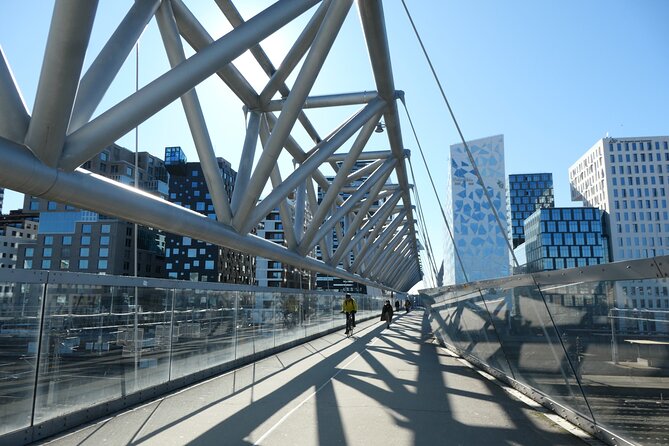
The Akrobaten Pedestrian Bridge links Grønland and Bjørvika. Its name refers to its acrobatic-looking form, and the bridge has become a recognizable piece of Oslo’s urban design.
This is a short stop of about 10 minutes, but it serves a clear purpose. The bridge lets you see how the newer waterfront is connected to an established neighborhood. Rather than treating Bjørvika as an isolated development, the route shows how people move between districts.
I find this kind of stop valuable because it is about more than taking a photograph. A bridge can reveal how a city works. Here, the crossing connects the modern cultural quarter with Grønland, helping you see Oslo as a collection of linked neighborhoods rather than a few separate attractions.
The stop is free, and there is no admission issue to worry about. You should, however, expect ordinary walking conditions and some time spent outside. The tour requires a moderate level of physical fitness, so it is best suited to people who are comfortable walking for two hours and keeping up with a group.
More city tours in Oslo:
- Oslo: City Sightseeing Hop-On Hop-Off Bus Tour
★ 3.6 · 724 reviews - Oslo: Grand City Sightseeing Tour by Bus with Fjord Cruise
★ 4.6 · 647 reviews - Oslo Combo Tour: Grand City Tour and Oslo Fjord Cruise
★ 4.5 · 555 reviews - City Sightseeing Oslo Hop-On Hop-Off Bus Tour
★ 3.0 · 455 reviews
Kvadraturen and Oslo’s older civic center
The modern waterfront is only half of the story. The tour also visits Kvadraturen, an older part of Oslo that helps explain what came before the current building boom.
This area is home to Oslo’s oldest restaurant and what was once the city’s original town hall. Those details give the walk a more human scale. You move from ambitious public architecture and large cultural buildings to streets connected with everyday meals, local government, and the older life of the city.
Kvadraturen is especially important because it prevents the tour from becoming a parade of new construction. The city’s identity is not being erased and replaced in one sweep. Old and new areas sit close together, and the route lets you compare them in a short period.
The supplied timing names three main stops, but the tour itself lasts about two hours. That leaves time for the walking connections, the Kvadraturen section, explanations from the guide, and the transitions between districts. You should think of the experience as a guided city walk rather than a series of admission-based attractions.
The ending at Deichman Bjørvika, Oslo’s central library, places you back in the newer cultural district. It is a practical finish if you want to continue exploring Bjørvika afterward. Since no hotel pickup or drop-off is provided, you are responsible for getting to the starting point and continuing on from the end.
What the $53.31 price really buys you
At $53.31 per person, this is a premium-priced short walking tour. You are paying mainly for the guide, route planning, and local context. The cost does not include entry to the Munch Museum, hotel transportation, or other paid attractions.
The price makes more sense if you value orientation. In two hours, you connect the Opera House, Munch Museum, Akrobaten Bridge, Bjørvika, Grønland, and Kvadraturen. You also avoid spending part of your first day working out how these areas relate to one another.
The price is harder to justify if you are happy to walk independently and read about the sights as you go. The Opera House roof is free, the bridge is free, and the public areas can be visited without joining a tour. You may prefer to spend the money on museum admission or another longer experience.
The guide is the part that can make or break the purchase. The strongest praise available focuses on a guide who was enthusiastic and well informed. That is encouraging, because the tour’s subject is urban change, and a good explanation adds far more than a list of building names.
A 98 percent recommendation rate and a 4.9 rating from 47 reviews also point to a consistently positive experience. The sample is not huge, so I would not treat those numbers as a guarantee. Still, they support the idea that the tour delivers what it promises: a well received introduction to Oslo’s contrasts.
Timing, meeting points, and practical comfort
The tour starts at 5:00 pm at Oslo Visitor Center, Jernbanetorget 1. This is near public transportation, which makes the meeting point convenient for many people already in central Oslo. You should arrive with enough time to find the visitor center and check your mobile ticket.
The walk ends at Deichman Bjørvika, at Anne-Cath. Vestlys plass 1. Since the start and end points are different, plan your onward route before you set off. Hotel pickup and drop-off are not included.
The tour operates in all weather. This is not a minor footnote in Oslo. Bring appropriate layers and footwear, and be ready for wind or rain, particularly around the waterfront and on the Opera House roof. The operator advises a moderate fitness level, which means the tour is not designed as a seated sightseeing experience.
Service animals are allowed. The experience is offered in English, and confirmation is provided when you book. The mobile ticket format is convenient, but you should keep your phone charged and accessible at the meeting point.
The walk is offered with a maximum of 20 participants. That group limit is one of the better features for a city tour. A smaller crowd makes it easier to hear explanations near busy public buildings and gives you a better chance to ask a question without holding up a large group.
Who will get the most from this walk
I would recommend this tour to first-time visitors who want a clear introduction to central Oslo. It is especially useful if you have limited time and want to understand the waterfront before deciding where to return independently.
It also suits architecture fans, city planners, photographers, and anyone curious about how former industrial areas become cultural districts. The Opera House and Akrobaten Bridge provide strong design-focused stops, while Bjørvika shows the broader redevelopment story.
The tour is a good fit for people who prefer explanation over simply collecting photographs. The buildings are attractive, but the guide’s commentary gives them purpose. You will come away with a better sense of why the city has invested in this part of Oslo.
I would hesitate to recommend it to someone whose main goal is to spend time inside the Munch Museum. Admission is not included, and the museum stop is short. Book a separate museum visit and use this walk for the city around it.
It may also be less suitable if you dislike scheduled walking or outdoor sightseeing in uncertain weather. The tour runs in all conditions, and the moderate fitness requirement should be taken seriously.
Cancellation and booking flexibility
You can cancel for a full refund up to 24 hours before the start time. Any cancellation or change made less than 24 hours before the 5:00 pm departure is not accepted for a refund, and the cutoff uses Oslo local time.
The experience is commonly booked about 13 days ahead. That is a useful planning guide, especially if your Oslo schedule is tight, but it does not guarantee that every date will sell out. Booking earlier gives you a better chance of fitting the 5:00 pm start into your plans.
Should you book Oslo City Walks?
Book this tour if you want a short, guided explanation of Oslo’s old and new sides, and you value having the route organized for you. The Opera House roof, the changing Bjørvika district, the Akrobaten Bridge, and Kvadraturen create a well-balanced two-hour introduction.
Skip it if you want a full Munch Museum visit, hotel transportation, or a longer historical tour. You can visit several of the public sights independently at no cost.
For most first-time visitors, I think the tour earns consideration despite its fairly high price. The strongest reason to go is not any single building. It is the connection between them, explained by an enthusiastic local guide in a small group. That makes Oslo’s rapid change easier to see, and much easier to understand.
FAQ
How long is Oslo City Walks, The City of Contrasts?
The walking tour lasts approximately two hours.
What time does the tour begin?
The tour starts at 5:00 pm.
Where does the tour meet?
The meeting point is Oslo Visitor Center at Jernbanetorget 1, 0154 Oslo, Norway.
Where does the tour finish?
The walk ends at Deichman Bjørvika, Anne-Cath. Vestlys plass 1, 0150 Oslo, Norway.
Is admission to the Munch Museum included?
No. Admission to the Munch Museum is not included in the tour price.
Is the Opera House roof visit guaranteed?
No. The route includes a roof stroll if time allows.
Is the tour available in English?
Yes. The tour is offered in English and includes a local guide.
What happens if the weather is bad?
The tour operates in all weather conditions, so you should dress appropriately.
Can I cancel for a refund?
Yes. You can cancel up to 24 hours before the experience begins for a full refund. Cancellations made less than 24 hours before the start time are not refunded.
Just added in Oslo
- Oslo Winter Highlights Bike Tour★ 5.0 · 36 reviews
- 4 hours Best View of the Oslofjord Winter Edition★ 4.0 · 15 reviews
- The Ultimate Study of the Human Form at Vigeland’s Sculpture Park with a Local★ 4.0 · 14 reviews
- Unknown war. Oslo and Norway during 1940-45★ 5.0 · 74 reviews
- Top of Oslo Snowshoe Tour★ 5.0 · 2 reviews
- The Scenic Roadtrip, Oslo to Bergen via Flam & the Fjords★ 5.0 · 25 reviews
- The Viking Planet Museum – Mini Group (4 adults)★ 4.0 · 16 reviews
- The Oslo Beer Adventure★ 4.5 · 11 reviews
City Tours, compared.
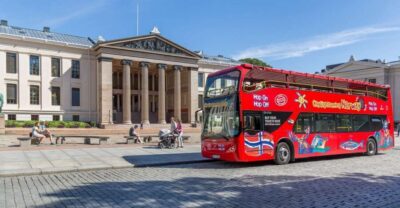
Grand City Sightseeing Tour by Bus with Fjord Cruise
Read our review →
Oslo Combo Tour: Grand City Tour and Oslo Fjord Cruise
Read our review →

Browse the lists this tour appears in